If you’ve ever bitten into a light, crunchy puffed snack like cheese curls, rice cakes, or corn sticks, you might not have given much thought to the unsung part of that process: the molds that shape it. As a puffed snacks processing machine supplier, I work with food manufacturers every day who tell me the mold they use is just as critical as the extruder itself. A bad mold can lead to inconsistent shape, texture, or even wasted product—no one wants a batch of cheese curls that stick together or have lopsided ends. Over the years, I’ve seen firsthand how different molds serve different needs, and I want to break down what’s available so you can make the right choice for your production. Puffed Snacks Processing Machine
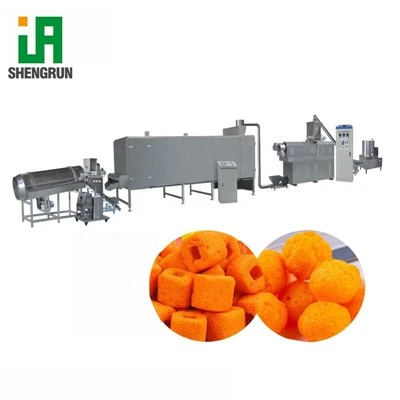
First, let’s start with the basics: puffed snack molds are custom-designed components that attach to the extruder machine’s die head. When the extruder pushes a mix of milled grains (corn, rice, wheat), water, and flavor additives through the mold, high pressure and heat expand the mixture as it exits, creating that iconic puffed texture. The mold’s shape, size, and even surface finish directly impact the final product. You can’t use the same mold for a crispy corn stick as you would for a soft rice cake, and that’s why there are several types to choose from.
Let’s walk through the most common options, starting with the simplest and most widely used: round hole molds. These are the go-to for basic puffed snacks like corn puffs or cheese curls. Round molds have uniform, circular holes ranging from 2 to 8 millimeters in diameter, depending on the desired snack size. The beauty of round hole molds is their versatility—they work with almost any grain base, and they’re easy to clean and maintain. For small to medium manufacturers just starting out, round hole molds are often the first investment. But here’s a tip I share with new clients: if you want a thicker, crunchier puff, go for a slightly larger hole. Smaller holes tend to produce lighter, airier snacks that can be fragile, so adjust based on your target market.
Next, shaped molds for novelty snacks. These are the molds that create fun, branded shapes—think star-shaped rice cakes, animal-shaped corn puffs, or even custom logos for a retail line. Shaped molds come in two main sub-types: fixed cavity and interchangeable inserts. Fixed cavity molds are made as a single piece, so they’re designed for high-volume, long-running products. For example, a snack manufacturer that makes a popular star-shaped puff year-round will use a fixed cavity mold because it’s durable and consistent. Interchangeable inserts are a better fit for smaller runs or brands that want to rotate shapes often. These inserts slot into a base mold, so you can switch from hearts to squares to dinosaurs without replacing the entire mold. I worked with a client last year who sells limited-edition holiday snacks, and interchangeable inserts let them create snowflakes for winter and pumpkins for fall without downtime. The key here is precision: shaped molds require tight tolerances to ensure each snack is identical, so always ask for a mold with smooth cavity walls to avoid product sticking.
Then there are textured surface molds, which are all about the final bite. Some snacks, like tortilla chips or puffed crackers, need a rough surface to hold seasonings or dip. Textured molds have patterns—ridges, dots, or a grid—etched into the cavity walls. These patterns don’t just make the snack look different; they also affect how the puffed product expands. A ridged mold, for example, creates a snack with a crisper edge that holds salt or cheese powder better than a smooth one. I’ve seen manufacturers use textured molds to reduce seasoning waste by up to 15%, since the pattern traps flavor instead of letting it fall off during packaging. For gluten-free puffed snacks, which are often softer, textured molds also help the product hold its shape longer after puffing, so it doesn’t break during shipping.
Now, let’s talk about specialty molds for unique snacks. If you’re venturing beyond standard corn or rice puffs, there are molds tailored to specific products. For example, ring-shaped molds are used for snacks like pretzel puffs or onion rings, which need a hollow center to mimic their non-puffed counterparts. Ring molds have a circular hole with a hollow core, so when the extruded product expands, the center stays empty. Another specialty type is sheet molds, which produce thin, flat puffed sheets that are later cut into chips or crackers. Sheet molds have a wide, flat opening instead of small holes, so the extruded mix comes out as a thin layer that puffs evenly. Sheet molds are popular with manufacturers that want to produce multiple products from one machine—they can switch to a round hole mold for curls and a sheet mold for chips without a major machine overhaul.
I should also mention adjustable molds, a newer innovation that’s been a game-changer for many clients. Adjustable molds let you change the hole size or shape on the fly without swapping the entire component. For example, an adjustable round hole mold can widen or narrow its holes to make small puffs for kids’ snacks and larger ones for adult-sized portions. This is perfect for mid-sized manufacturers that want to cater to multiple product lines without investing in separate molds. The only downside? Adjustable molds tend to be slightly more expensive upfront, but the time and money saved on product changeovers make them worth it for many businesses.
Now, when choosing a mold, there are a few factors to keep in mind that go beyond just shape. First, material: most puffed snack molds are made from stainless steel, which is food-safe, durable, and easy to clean. Some cheaper options use aluminum, but they’re not suitable for high-heat extrusion and can wear out quickly. I always advise clients to stick to food-grade stainless steel—it’s a small extra cost that pays off in longer mold life and consistent product. Second, mold size: make sure the mold fits your specific extruder model. Not all extruders have the same die head size, so a mold that works for one machine might not work for another. As a supplier, I always provide custom mold measurements to match my clients’ equipment, because a ill-fitting mold will cause jams, uneven puffs, and wasted product. Third, maintenance: molds need regular cleaning to prevent buildup of grain or flavor additives. Look for molds that are easy to disassemble and clean, especially if you’re switching between different product flavors. Some textured molds can be harder to clean, so if you’re a brand that changes flavors frequently, opt for smooth or simple textured patterns.
I’ve seen too many manufacturers skip the right mold and end up with batches of product that don’t sell. A client of mine a couple years ago tried to use a round hole mold to make a star-shaped snack, and the result was lopsided, sticky puffs that had to be discarded. After switching to a custom shaped insert mold, their product line took off. That’s why I always say the mold is an investment, not just a part. It’s what turns your extruded mix into the snack your customers want.

At the end of the day, the best mold for your puffed snacks depends on your product line, production volume, and budget. Whether you’re a small startup looking for round hole molds to launch your first corn puffs, or a large manufacturer needing interchangeable inserts for seasonal products, there’s a mold that fits your needs. If you’re looking to upgrade your molds or set up a new puffed snack line, don’t hesitate to reach out to discuss your specific requirements. Let’s work together to find the right mold to make your puffed snacks stand out in a crowded market.
Fried Snacks Processing Machine References
- Food and Agriculture Organization of the United Nations. (2019). Extrusion Technology for Puffed Food Products. FAO Agriculture and Food Series.
- Toledo, R. T. (2007). Fundamentals of Food Process Engineering (3rd ed.). Springer.
- American Society of Mechanical Engineers. (2021). Design Guidelines for Food Processing Equipment. ASME Press.
- Zhang, Y., et al. (2020). Effect of Mold Design on the Quality of Extruded Puffed Corn Snacks. Journal of Food Engineering, vol. 278.
Jinan Shengrun Machinery Co., Ltd.
We are one of the most professional puffed snacks processing machine manufacturers and suppliers in China, featured by quality products and good price. Please rest assured to buy durable puffed snacks processing machine for sale here from our factory. Contact us for more details.
Address: 1817 Rongce Center, No.3179 Qilu Avenue, Xingfu Street, Huaiyin District, Jinan City, Shandong Province
E-mail: sales@foodgm.cn
WebSite: https://www.food-gm.com/
