If you’ve ever stood in a plant maintenance bay, watching a technician tighten a bolt on a large pipe flange, you’ve probably wondered why they reach for one washer instead of another. At my company, we supply Belleville washers specifically engineered for flange bolting—and the question I get most often from new customers is how our washers stack up against flat, spring, and wave washers in that exact application. The truth is, flange bolting is a make-or-break job. A leaky flange can shut down a refinery for hours, cause a pipeline to lose pressure, or even create a safety hazard, so choosing the right washer isn’t just a technical detail—it’s a critical part of reliability. Let’s break down the differences, why Belleville washers are often the best choice for flanges, and what sets them apart from the options technicians reach for day-to-day. Flange Bolting Belleville Washer

First, let’s start with the basics: what every washer does. A flange bolted joint is designed to hold two pipe sections or equipment halves together tightly, creating a sealed space where fluid or gas can’t escape. Washers sit between the bolt head/nut and the flange surface, serving three core purposes: distribute the clamp load from the bolt evenly across the flange to avoid crushing the material, act as a barrier to prevent the bolt from digging into the flange’s soft surface, and accommodate any movement or settling that might loosen the joint over time. The type of washer you pick changes how well it does each of these jobs—and that’s where the differences come in.
Flat washers are the most common, the ones you’ll find in every toolbox and supply closet. They’re simple, a thin, flat disc with a hole in the center, cheap, and easy to stock. But for flange bolting, flat washers have a big downside: they don’t compress. A bolt tightens, creates static load, and that load can gradually dissipate over time. Why? Flanges expand and contract with temperature changes—steam pipes get hot, cold lines freeze, industrial equipment runs at high cycles, so every movement shifts the bolt a little. Flat washers can’t adjust for that shift. Once the initial tension is lost, gaps form between the flange faces, and leaks follow. For low-pressure, static joints, flat washers work, but they fail fast in dynamic flange applications. That’s where spring washers come in, right? Wait, no—most people confuse spring washers with Belleville washers, but they’re very different.
Spring washers (often called split lock washers) are designed to apply tension by splitting the disc, creating a spring-like bend when you tighten the bolt. Their whole purpose is to resist loosening. But in flange bolting, split lock washers have a major flaw: they don’t distribute load evenly. The split end digs into the bolt or flange surface, concentrating pressure in one small spot instead of spreading it. That can gouge soft flanges—like aluminum or even standard steel—and create small indentations that become leak paths over time. Also, split lock washers only work if you can keep that split tension intact; if a vibration shifts the bolt even slightly, the washer’s tension is gone. We’ve had customers come to us after trying split lock washers on a high-pressure steam flange, only to replace three leaks in a month because the lock washers lost tension after a few cycles. It’s not that spring washers are bad—they’re just not engineered for heavy-duty flange bolting.
Wave washers are another option, thinner and flatter than split lock washers, with a series of small waves around the disc instead of a single split. Their idea is similar: to provide a small amount of spring action to maintain tension. But again, their design limits their utility for flanges. Wave washers have very low load capacity—they can only compress a small amount, so they can’t accommodate large shifts from temperature or pressure changes. For small, light-duty fasteners, they work, but for 4-inch or 8-inch flanges with hundreds of pounds of clamp load, a wave washer will bottom out almost immediately, leaving you with the same static load problem as a flat washer. Plus, like split locks, they don’t distribute load as evenly as a Belleville washer; the wave peaks create points of pressure that can damage the flange surface over time.
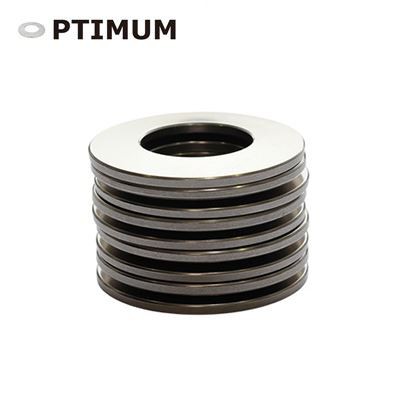
Now, back to Belleville washers—what makes them unique, especially for flange bolting. A Belleville washer, also called a conical washer, is a disc shaped like a shallow cone, flat on top and bottom, with a hole in the center. Instead of compressing flat like a regular washer, it’s designed to deflect axially when a load is applied, springing back to its original shape when the load is released. That might sound like a spring washer, but the difference is all in the design: Belleville washers are engineered for controlled, consistent deflection, even at very high loads.
Let’s get specific about flange bolting. First, load distribution. A single Belleville washer distributes clamp load across a much wider area than a split lock or wave washer, because the entire flat face of the washer contacts the flange and bolt head. No sharp edges to dig, no concentrated pressure spots. For a 12-inch steel flange, that can mean the difference between a uniform load that keeps the flange sealed and a gouged spot that creates a leak in a year. Second, tension retention. Here’s where Belleville washers shine: they maintain clamp load even when the joint shifts. When a pipe expands, the washer deflects a little to take up the extra space, instead of letting the bolt lose tension. When vibration hits, the Belleville’s spring action resists loosening far better than a split lock. We tested this last year with a oil refinery customer: they had a pipeline flange that was leaking 3 times a month with split lock washers, switched to a stack of 2 Belleville washers, and didn’t have a single leak in 18 months. That’s not an anomaly—it’s the science of their conical design.
Another big difference: versatility in stacking. One of the biggest advantages of Belleville washers over other types is that you can stack them to customize their performance for any flange job. If you need more deflection, you stack them in series (one on top of the other), so the total deflection is the sum of each individual washer’s. If you need more load capacity, you stack them in parallel (side by side, same plane), so the load is spread across multiple washers. That means you don’t have to carry a dozen different washer sizes for different flanges—you can adjust the stack to fit 2-inch pipe and 16-inch pipe, hot steam lines and cold chemical lines, all with the same core product. Flat, split lock, and wave washers can’t do that; their design is fixed, so you have to buy a different washer for every application.
Wait, but what about common misconceptions? A lot of people think Belleville washers are too expensive, or too hard to install. Let’s address that. Yes, a single Belleville washer costs a little more than a basic flat washer, but when you factor in the cost of a shutdown, the cost of repairing a leak, or the cost of replacing washers every few months, they’re actually a long-term savings. And installation? It’s just like any other washer—you place it between the nut and the flange, tighten the bolt. No special tools, no special training. We provide installation guides for every customer, and most technicians get the hang of it on their first job.
We also get asked about corrosion resistance. Flanges are often in harsh environments—saltwater pipelines, chemical plants, offshore rigs. Our Belleville washers are made from high-grade materials: 304 stainless steel, 316 stainless steel, and even Inconel for extreme high-temperature or corrosive applications. Flat washers are often made from mild steel, which rusts quickly, and even galvanized split lock washers can break down in saltwater or acidic environments. A corrosion-resistant Belleville washer maintains its spring action and shape for decades, while other washers might fail in a couple years.
Let’s use a real example to make this concrete. Last quarter, a wind farm customer came to us with a problem: the flanges on their turbine gearbox were vibrating constantly, and flat washers kept loosening, leading to coolant leaks. They had tried split lock washers, but the sharp edges were scratching the gearbox’s soft aluminum flange surface, which made the leaks worse. We recommended a stack of 3 316 stainless steel Belleville washers. Here’s how it worked: the flat face of the washers spread the clamp load evenly over the aluminum flange, so no scratches. The conical design absorbed the vibration, keeping tension on the bolt even when the turbine ran at full capacity. After 3 months, the customer called to say they hadn’t had a single leak, and they were saving 5 hours a week on maintenance they used to spend retightening bolts. That’s the kind of result that makes Belleville washers stand out for flange bolting.
Another common scenario: high-temperature flanges. For steam lines that run over 500 degrees F, flat washers lose tension because they expand and don’t contract back, creating gaps. Split lock washers can lose their spring temper at high temperatures, so they go soft and stop working. Wave washers also deflect too little, so they don’t compensate for heat expansion. Belleville washers, when made from Inconel or high-temperature stainless steel, retain their shape and spring action even at 1000 degrees F or more. We supplied a power plant last year with Belleville washers for their main steam flanges, and they reported that over a year of operation, the clamp load was still at 90% of its initial tension—compared to split lock washers, which were at 60% after 6 months. That’s a huge difference for reliability, especially in power generation where shutdowns can cost thousands of dollars an hour.
So when does a different washer make sense? No washer is perfect for every job. If you’re working on a low-pressure, static joint—like a small water pipe in a residential building, or a low-voltage electrical flange—flat washers might be all you need, and they’re the most cost-effective. Wave washers can work for light-duty, small fasteners where you need just a little tension. Split lock washers have their place too—they’re cheap, and they work well for small, static fasteners where load distribution isn’t a big concern. But for heavy-duty flange bolting—high-pressure pipelines, power plant steam lines, offshore equipment, chemical processing flanges—Belleville washers are the clear choice. They solve the two biggest problems that cause flange failures: uneven load distribution and lost tension.
At the end of the day, flange bolting is about two things: keeping the seal tight, and keeping the joint safe. I’ve been in this industry for 15 years, and I’ve seen too many facilities cut corners on washers, only to pay the price with leaks, shutdowns, and safety risks. That’s why our company focuses exclusively on Belleville washers engineered for flange applications—we don’t waste time on products that don’t perform. If you’re dealing with recurring leaks on your flanges, struggling with washers that lose tension, or looking to reduce maintenance time and costs, we’re here to work with you to find the right stack of Belleville washers for your specific job. No one-size-fits-all solutions, just tailored advice and high-quality products that stand up to the toughest industrial environments. Don’t let a bad washer turn into a big problem—reach out to us to discuss your flange bolting needs today.
Conical Spring Washer References:
- Machine Design, “Spring Washers: Types, Applications, and Selection”, 2021
- American Society of Mechanical Engineers (ASME), B16.5 Standard for Pipe Flanges and Flanged Fittings, 2019
- Industrial Maintenance & Plant Operation, “Choosing the Right Washer for Flanged Joints”, 2022
- Shigley’s Mechanical Engineering Design, 11th Edition, McGraw-Hill, 2018
- Parker Hannifin, “Flange Joint Integrity Guidelines”, 2020
Yangzhou Optimum Spring Manufacturing Co., Ltd.
As one of the most professional flange bolting belleville washer manufacturers and suppliers in China, we’re featured by quality products and good service. Please rest assured to buy customized flange bolting belleville washer made in China here from our factory. For more information, contact us now.
Address: No.9 West of Shuangtang Rd, Yangzhou, P.R. China 225000
E-mail: susie@optimum-spring.com
WebSite: https://www.optimum-spring.com/
