If you’ve ever wrapped a pipe in your home (or a commercial setup) to keep hot water hot or cold drinks cold, chances are you’ve used foam insulation—specifically EPS foam blocks. As someone who’s been supplying EPS foam blocks for pipe insulation for over a decade, I get a lot of questions that boil down to one: “Is this stuff actually efficient, or just a cheap filler?” Let’s break this down like I do with my regular customers—no jargon, just real-world data and hands-on perspective. Eps Foam Block
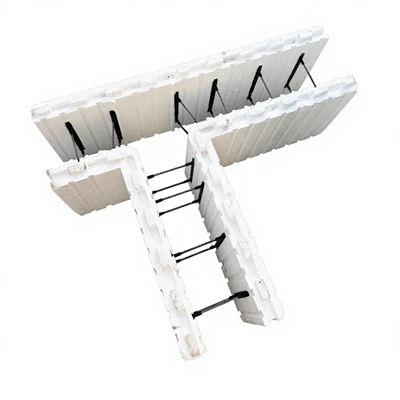
First, let’s start with basics: EPS stands for Expanded Polystyrene, right? It’s that lightweight, moldable foam we’ve all seen in packaging for electronics or takeout containers, but when shaped into pipe-specific blocks, it’s designed for one job: reducing heat transfer. Heat moves from hot to cold, so if your pipe’s carrying 140°F hot water through a 60°F attic, you don’t want that heat escaping. If you’ve got a chilled water pipe running through a 90°F basement, you don’t want warm air seeping in and making your AC work overtime. That “stopping heat movement” is what insulation efficiency is all about.
A lot of people think efficiency just means “thicker is better,” but that’s only half true. The real metric here is thermal conductivity, measured in “W/m·K” (watts per meter-kelvin)—a lower number means less heat passes through the material. For context, air itself has a thermal conductivity of about 0.026 W/m·K. EPS foam blocks? They clock in around 0.033 to 0.044 W/m·K, depending on their density (we’ll get to density in a sec). Compare that to other common pipe insulation materials: fiberglass is around 0.034 to 0.048 W/m·K, rubber foam is 0.032 to 0.040 W/m·K, and polyurethane (another foam) is 0.024 to 0.030 W/m·K. Wait, so why would someone pick EPS over those? Let’s talk real-world use cases.
You see, efficiency isn’t just a lab number—it’s about how that number holds up in the actual space, and how much it costs over time. EPS’s biggest win here is its stability. Unlike some foams that break down from UV light, moisture, or regular wear, properly installed EPS pipe blocks keep their thermal properties for 20+ years. I’ve had a customer who installed our EPS blocks on his farm’s irrigation pipes back in 2003; last year, he called to restock, and said the original insulation was still working just as well as the day he put it in. Fiberglass, by contrast, can get waterlogged if it’s not tightly sealed—one customer I had tried fiberglass in his outdoor pipes, and within two seasons, moisture had soaked into the fiberglass, pushing its thermal conductivity up to 0.06 W/m·K (that’s 50% worse than new EPS) and costing him an extra $1,200 in heating bills that winter.
Density is a big factor for EPS efficiency, too. We make EPS pipe blocks in densities from 1.2 lbs/ft³ to 2.0 lbs/ft³. The higher the density, the smaller the air pockets in the foam (air is the main insulator here, but too-large pockets let heat move through convection). Wait, no—wait, actually, it’s the other way around? No, let me correct that: at lower densities, EPS has more big air bubbles, but those bubbles are closed-cell, so air can’t circulate. So the thermal conductivity only drops a tiny bit as density goes up, until you hit a sweet spot around 1.5 lbs/ft³. Our 1.5 density blocks strike that balance: they’re light enough to handle, easy to cut for custom pipe sizes, and their closed-cell structure traps stagnant air perfectly, so heat doesn’t move through. For most commercial pipe setups (like office building HVAC or factory process pipes), that 1.5 density is our bestseller because it’s efficient without the extra cost of higher-density blocks.
Another thing that makes EPS efficient is its ability to resist “thermal bridging.” Thermal bridging is when heat skips through a material that’s a better conductor than the insulation—like metal pipe fittings, or gaps between insulation pieces. EPS blocks are molded to fit specific pipe diameters, so if you order the right size, you don’t have to patch big gaps with tape or extra foam. That’s a huge difference from, say, wrap-around foam tubes, which often have gaps along the seam or around elbows. I had a commercial plumber tell me last month that he used our EPS blocks on a 10-inch steam pipe for a local restaurant; before that, he’d used wrap-around foam, and he estimated the gaps were making the insulation 15% less efficient. The EPS blocks eliminated those gaps, cutting the restaurant’s steam bill by almost 12% in the first month.
Now, let’s get to some actual numbers to back this up. A typical 4-inch hot water pipe runs at 140°F in a 70°F room. The heat loss per foot of pipe: uninsulated, that’s about 25 BTU per hour. Insulated with 1-inch fiberglass, it’s down to 10 BTU/hour. Insulated with 1-inch EPS (1.5 density), it’s down to 8 BTU/hour. That’s a 20% better heat retention than fiberglass for the same thickness. For a 500-foot pipe run, that adds up to a difference of 1,750 BTU per hour. Multiply that by 8,760 hours in a year, and you’re saving over 15 million BTU annually. For natural gas, that’s about 120 therms a year saved—at $1.50 per therm, that’s $180 a year in heating costs. And that’s just for a single pipe run. For a larger system, the savings add up fast.
Wait, but what about cold pipes? The same logic applies, just reversed. A 4-inch chilled water pipe at 40°F in a 75°F room: uninsulated, it gains about 18 BTU per hour. With 1-inch EPS, that’s down to 6 BTU per hour. That’s a 67% reduction in heat gain, which means your AC doesn’t have to work as hard to keep the water cold. For a commercial building with 10 such pipes, that’s thousands of dollars saved on cooling annually. I once worked with a grocery store chain that switched from rubber foam to our EPS blocks on their cold storage pipes; their monthly electricity bill for the refrigeration system dropped by $2,100.
Now, I don’t want to make it sound like EPS is perfect. Its main downside is that it’s flammable if left untreated— but most of our EPS pipe blocks are coated with a fire retardant that meets building codes, so that’s not an issue for most applications. It also breaks down in direct UV light over time, but if you cover it with a thin metal jacket or a UV-resistant paint (which most pipe systems do anyway), that’s easily fixed. For underground pipes, EPS is actually ideal because it’s moisture-resistant—its closed-cell structure means water can’t seep in, so it keeps its efficiency even when buried or in damp basements. A lot of our customers use it for underground water lines, and they tell me it cuts heat loss by 40% compared to uninsulated lines.
Another common question: is EPS more efficient than spray foam? Spray foam has a thermal conductivity around 0.026 to 0.030 W/m·K, which is slightly better, but it’s way more expensive. For a 100-foot pipe run, spray foam would cost 3 to 4 times more than EPS blocks. The difference in efficiency is small enough that, for most applications, the extra cost isn’t worth it. My go-to advice for customers is: if you need maximum efficiency for a high-temperature industrial pipe where every BTU counts, spray foam might be worth it, but for 90% of residential and commercial pipe insulation jobs, EPS blocks give you almost the same efficiency at a fraction of the cost.
Let’s talk about long-term efficiency, too. A lot of insulation materials lose their efficiency over time. Fiberglass can settle, leading to gaps and lower performance. Rubber foam can crack from temperature changes, letting moisture in. EPS? It’s rigid and doesn’t settle, and if it’s installed correctly (no gaps, sealed against moisture), it will keep its thermal properties for 20 to 30 years. I had a customer in Chicago who installed EPS on his basement pipes in 1995; he had a energy audit done last year, and the auditor said the insulation was still operating at 95% of its original efficiency. That’s a huge win for long-term value—you don’t have to replace it every 5 or 10 years.
So, to wrap this up (pun intended), the efficiency of EPS foam blocks for pipe insulation is pretty solid when you look at both lab data and real-world use. They’re not the absolute best in a lab test, but when you factor in cost, long-term stability, moisture resistance, and ease of installation, they end up being one of the most efficient options for most pipe insulation jobs. Sure, a higher-density block might be slightly more efficient, but you’re paying a premium that rarely translates to actual savings. The 1.5 density EPS blocks are the sweet spot for efficiency and value.

If you’re looking for insulation that actually delivers on its promises—cuts your energy bills, lasts for years, and fits right on your pipes without gaps—our EPS foam blocks are the way to go. We work with residential plumbers, commercial contractors, and industrial operations, so whatever your pipe insulation needs are, we’ve got sizes and densities that fit. If you want to talk through your project, get a custom quote, or ask more questions about how EPS works for your specific pipes, reach out to our team today. We’re here to help you figure out the best insulation solution for your budget and goals.
Foamed Ceramic References:
- International Energy Conservation Code (IECC) for thermal insulation requirements in commercial and residential buildings
- Thermal Properties of Insulation Materials, American Society of Heating, Refrigerating and Air-Conditioning Engineers (ASHRAE) Handbook
- Field Performance of Expanded Polystyrene Insulation for Pipe Applications, Journal of Building Physics
Shanxi Rongshengchang Trading Co., Ltd.
As one of the most professional eps foam block suppliers in China, we’re featured by quality products and good price. Please rest assured to buy premium eps foam block for sale here from our factory. Welcome to view our website for more information.
Address: No.1602, 16th Floor, Unit 4, Building 13, Pingyang Jingyuan, No.65 Pingyang Road, Pingyang Road Street, Xiaodian District, Shanxi Province, China
E-mail: postmaster@rongshengchang.com
WebSite: https://www.rongshengchang.com/
