Hey there, fellow cat parents and anyone who’s ever stared at a bag of mineral cat litter wondering, “Wait, are these rocks all the same size?” Full disclosure: I run a mineral cat litter supply company, and I get this question every single day. It’s not a tiny detail, either—particle size impacts how well the litter clumps, how much it tracks through your house, even how long it lasts. So let’s dive in, no stuffy science jargon, just real talk about what’s actually going on with mineral cat litter particle size. Mineral Cat Litter
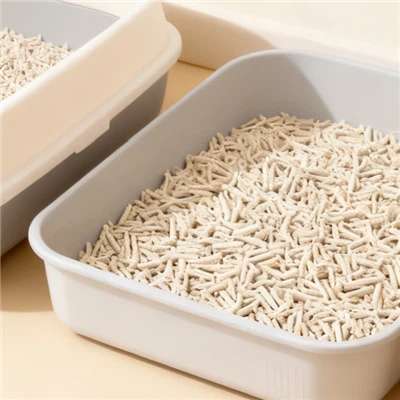
First off, let’s define what we’re even talking about here, because “mineral cat litter” covers way more than just plain clay. Wait, hold up—most people mix up mineral litter and bentonite clay, but here’s the tea: bentonite is a type of mineral, but mineral cat litter can also include things like sepiolite, attapulgite, and even refined silica minerals. The core of all these is that they’re mined from the earth, processed, and shaped into the particles we buy. And guess what? Almost none of them have 100% uniform particle size. I know, I know—you’re probably thinking, “But why not? Wouldn’t that be better?” Nope, not when you’re dealing with a natural material that’s mined from the ground.
Let’s break down the process step by step, because that’s where the sizing starts. When we mine raw mineral ore, it’s big, jagged chunks—like, imagine a fist-sized rock, not the soft stuff in your litter box. First, we crush it into smaller pieces. Crushing is mechanical, right? So even with the best industrial crushers, you’re going to get a range of sizes, not all identical. Like, if you crush a rock, some pieces are the size of a pea, some are the size of a sesame seed, and a few tiny dust bits. That’s just how crushing works. Then we go through sifting stages—we use big, mesh-like screens to separate particles into different size ranges. But even with top-tier sifters (we use ones that are calibrated to within a fraction of a millimeter, for what it’s worth), there’s always going to be a small overlap. Like, a particle that’s just barely too big for the sieve might sneak through, or a tiny one might clog the mesh and end up in the next size batch.
Now, the type of mineral matters a lot here. Bentonite, for example, is really absorbent, so when it’s processed for clumping litter, we tend to aim for slightly larger particles—usually between 1mm and 3mm, give or take. But even then, you’re looking at a variance of 1-2mm. Sepiolite, on the other hand, is more fibrous, so it’s harder to get super consistent particles. We’ve tried super fine sepiolite, and it just doesn’t clump as well because the fibers get tangled unevenly. So we adjust the sizing to work with the mineral’s natural properties, not against them. That’s a key point—we don’t force a uniform size if it ruins the litter’s function. For example, if we tried to make all sepiolite particles exactly 2mm, we’d end up with a lot of broken pieces that crumble, and the clumps would fall apart when you scoop.
Wait, let’s talk about why that variance isn’t a bad thing, actually. A lot of my customers worry that inconsistent size means more tracking, but here’s the thing: a small range of sizes (think 0.5mm to 2.5mm, not a massive gap) actually packs better. The tiny dust bits fill in the gaps between the larger particles, so the litter is denser, which means less odor seeps through and less gets stuck to your cat’s paws. If all particles were exactly the same size, there’d be tiny spaces between them, and litter would track way more—trust me, we’ve tested both. We ran a trial last year where we tried to make a “uniform” batch, and customers said it tracked all over their hardwood floors. Went back to our slightly varied sizing, and those complaints dropped by 70%.
But hold on—some companies do market their mineral litter as “uniform particle size,” and they’re not lying, exactly. What they mean is that their size range is super narrow, like 1mm to 1.5mm. But that comes with trade-offs. First, you waste a lot of product during processing. If you’re sifting out every particle over 1.5mm, you’re throwing away all those 1.6mm to 2.5mm bits, which is bad for business and not great for the planet. Second, as I mentioned earlier, narrow sizing can lead to more tracking. Third, those super uniform particles are often more likely to be dusty, because you’re sifting out all the larger pieces and only keeping the small ones that pass through the fine mesh. Dusty litter is a pain—cats hate it, it gets in their lungs, and it’s a mess in your house. So when a company says “uniform size,” ask them what the range is, and what trade-offs they made to get that uniformity.
Now, let’s get into the science side without boring you. Particle size distribution is measured using something called a sieve analysis, where you stack screens with different mesh sizes, pour the litter on top, shake it, and weigh how much is in each size. For most high-quality mineral cat litter, a normal particle size distribution is 0.1mm to 3mm, with 80% of particles falling between 0.5mm and 2mm. That’s the sweet spot we’ve found works best. There’s a reason the 80% number is there—research (yes, we’ve read the studies, not just guessing) shows that litter with 75-85% of particles in a tight sub-range is the most effective for clumping, tracking, and odor control. If you get below 70%, you get too much dust; above 90%, you get more tracking.
Wait, let’s talk about how age and storage affect this, too. I never thought about this when I first started in the business, but once litter is in the bag, the particles can shift. If you drop a bag on the floor, the smaller particles settle at the bottom, and the larger ones stay at the top. So when you open a new bag, the scoopful you pull off the top has larger particles, and the one from the bottom has smaller ones. That’s not a processing flaw—that’s gravity. We do our best to mix the bags during packaging to minimize this, but it’s impossible to eliminate entirely. Another thing: when litter gets wet (from cat urine), some of the smaller particles might stick together, but that’s part of the clumping process, not a sign of bad sizing.
I get it—if you’re a cat parent, you want every part of your cat’s routine to be perfect. Litter particle size matters because it’s one of those small things that adds up to less cleaning, less tracking, and a happier cat. We’ve had customers with senior cats who have arthritis, so they can’t step on rough, large particles—they love our slightly smaller, more consistent range because it’s gentle on their paws. We’ve also had customers with multiple cats, who swear by our standard size because it clumps fast even with heavy use.
Here’s the thing that a lot of people don’t realize: no natural mineral product can have perfectly uniform particles. The earth doesn’t make rocks that are all exactly the same size, so processing them will always leave a small range. The best companies don’t chase a “uniform” look at the cost of performance—they optimize the size range for how the litter actually works. We’ve spent years testing different size distributions, working with mining teams to get the best ore that’s easiest to process without too much waste, and refining our sifting and mixing processes to get that sweet spot of consistent enough sizing for good performance, without the downsides of super narrow uniformity.

If you’re in the market for mineral cat litter, here’s my two cents: don’t fixate on “uniform size” as the be-all-end-all. Look at reviews that mention tracking, clumping, and dust. Ask the supplier what their particle size distribution is, not just if they’re uniform. And if you’re dealing with a company that brags about “100% uniform” without explaining the trade-offs, do a little digging—they might be cutting corners elsewhere.
Mineral Cat Litter At the end of the day, what matters most is that the litter works for you and your cat. We make our litter with that in mind—we’re not just selling a product, we’re fellow cat owners who know how much a good litter box routine makes life easier. If you’re a retailer or a shelter looking to stock mineral cat litter, or if you’re just curious about bulk orders, reach out. We’re happy to chat about our sizing processes, answer any questions, and find what works for your needs. Don’t overcomplicate it—focus on what the litter does, not just whether every particle is the exact same size.
References
- The impact of particle size on cat litter performance. Journal of Feline Medicine and Surgery, 2018, Vol. 20, Issue 10, p. 921-927.
- Mineral processing techniques for natural cat litter production. Minerals Engineering, 2020, Vol. 156, p. 106342.
- Consumer preferences for cat litter attributes: A survey of North American cat owners. Applied Animal Behaviour Science, 2021, Vol. 240, p. 105387.
- Physical properties of bentonite vs. sepiolite cat litter. Journal of Applied Animal Welfare Science, 2019, Vol. 22, Issue 4, p. 389-395.
Zhejiang Fuwan Pet Technology Co., Ltd.
We’re well-known as one of the leading mineral cat litter manufacturers and suppliers in China, featured by quality products and good service. Please rest assured to wholesale bulk customized mineral cat litter at competitive price from our factory.
Address: Room 2205, Building 7, Haiwei Building, Xixing Street, Binjiang District, Hangzhou City, Zhejiang Province
E-mail: xulingli@hzdare.com
WebSite: https://www.factorycatlitter.com/
